
◆ RESEARCH & KNOWLEDGE HUB

The science, in plain language.

Peptides and GLP-1 medications can sound complicated. They don’t have to be. Here’s how they actually work — explained simply, with visuals, a glossary, and summaries of real studies.

THE BASICS

What are peptides?

Tiny messengers that tell your body what to do.

In one sentence: Peptides are small chains of amino acids that act like text messages between your cells.

Your body is full of proteins. Peptides are just shorter versions of those — small strings of amino acids (usually 2 to 50 of them) linked together.

Instead of building muscle or tissue like big proteins do, many peptides work as signals. They travel to a cell, attach to it like a key in a lock, and deliver an instruction: release this hormone, repair this tissue, feel full. Some hormones you already know — like insulin — are actually peptides.
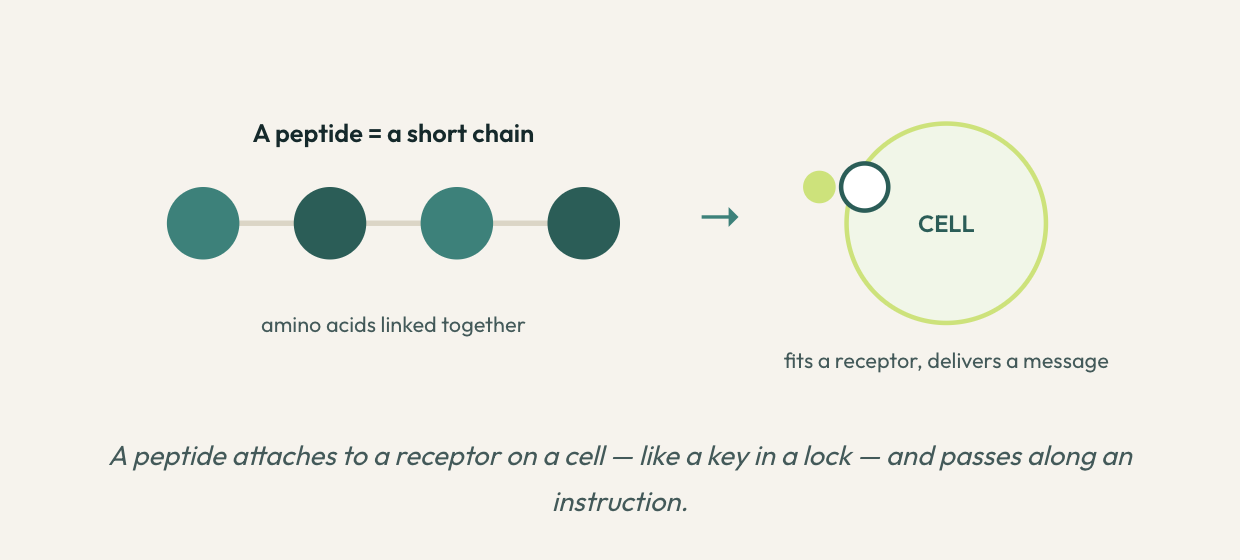
Think of it like: a key ring. Each peptide is a differently-shaped key. It only opens the one lock it was cut for — which is why peptides can be so targeted.

How you take a peptide depends on the peptide. Most are given as a small injection under the skin, but some come as capsules, nasal sprays, or creams. Many peptides used for wellness are still being studied and aren’t FDA-approved for those uses — which is why a provider’s guidance matters.

WEIGHT LOSS

Single, dual & triple agonists

Why newer medications hit more than one target.

In one sentence: Older medications press one “button,” newer ones press two or three — which can mean more weight loss.

An “agonist” is just something that switches a receptor on. Your body has a few different metabolic receptors. How many a medication activates is what separates the generations.
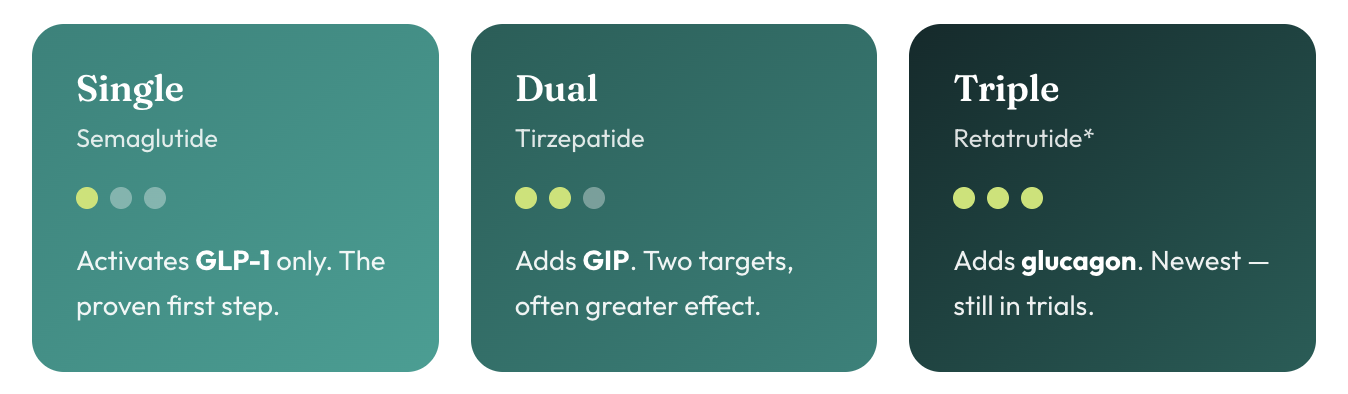
Each extra target is another lever on metabolism and appetite. In studies, adding targets has generally meant more weight loss on average — though more isn’t automatically “better for everyone.” Side effects, cost, and your health history all matter.

*Retatrutide is investigational — it’s still in clinical trials and not FDA-approved. A licensed provider decides what’s appropriate for you.

COMPARISON

Semaglutide vs. tirzepatide

What a head-to-head study actually found.

In one sentence: In the first direct comparison, tirzepatide led to more weight loss on average — but both worked well.
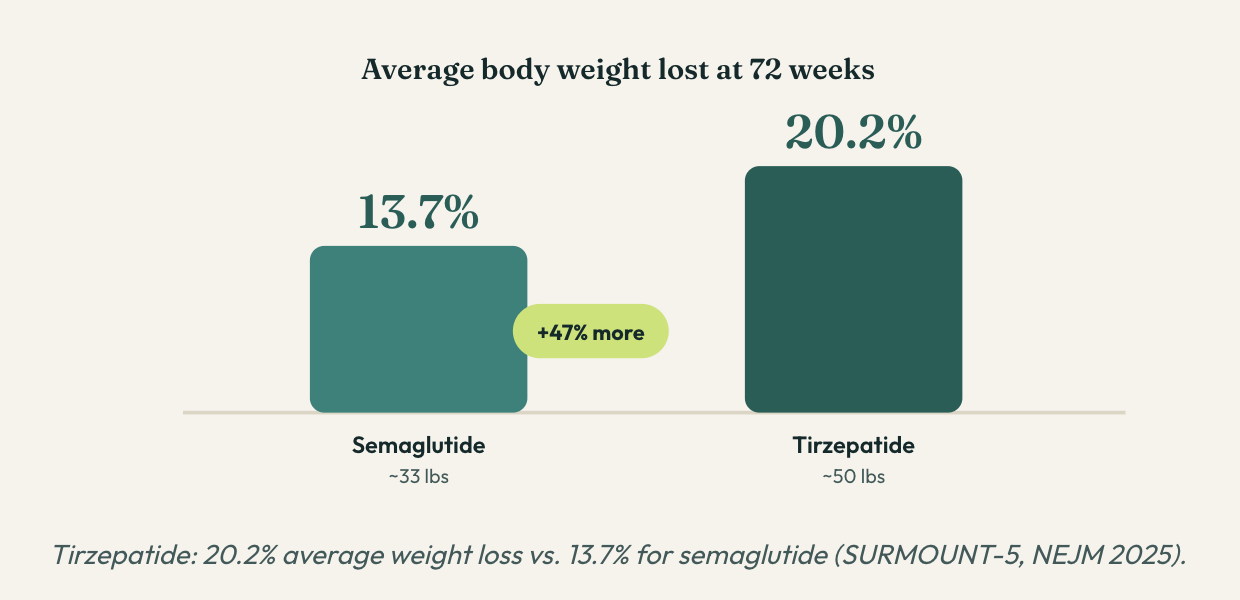
In 2025, a large study (called SURMOUNT-5) put the two side by side for the first time — 751 adults, 72 weeks. Here’s the headline result:

About 1 in 3 people on tirzepatide lost a quarter of their body weight or more, versus about 1 in 6 on semaglutide. Side effects differed too: semaglutide leaned toward nausea, tirzepatide toward diarrhea — mostly during the early dose-increase phase.

The takeaway: tirzepatide won on average, but “best on average” isn’t the same as “best for you.” Both are effective tools, and the right choice depends on how your body responds, tolerability, and cost.

RECOVERY

Recovery & repair peptides

The ones people use for healing — and the honest caveat.

In one sentence: Peptides like BPC-157 look promising for healing in early research, but most evidence is still from animal studies.

BPC-157, TB-500, and GHK-Cu are the peptides people talk about for recovery. BPC-157 is the most studied. Researchers think it helps the body’s natural repair crew work faster.

This is especially interesting for tendons and ligaments, which normally heal slowly because they get little blood flow. A 2025 review of 36 studies found BPC-157 consistently improved healing outcomes across these models.

The honest part: almost all of that research is in animals, not people. Human studies are still rare, there’s no official dosing standard, BPC-157 isn’t FDA-approved, and it’s banned in pro sports. Promising — but early.

LONGEVITY

Longevity & NAD+

The “cellular battery” molecule everyone’s talking about.

In one sentence: NAD+ helps your cells make energy, it drops as you age, and topping it up is a hot research area — with results still coming in.

Every cell has tiny power plants called mitochondria. To make energy, they rely on a helper molecule: NAD+. As we get older, NAD+ levels fall — and scientists wonder if that decline is part of why we feel the effects of aging.
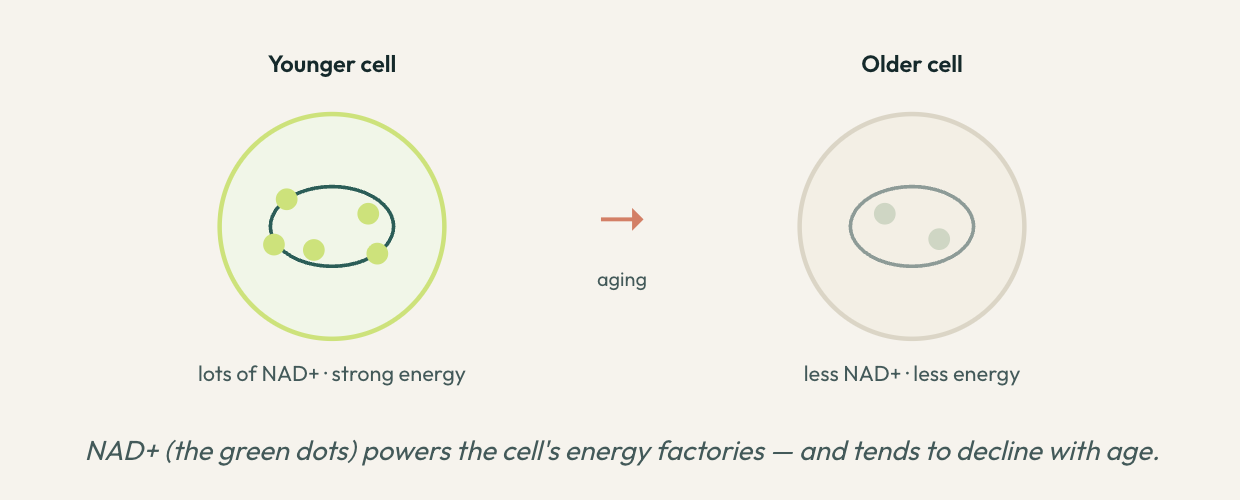
Think of it like: a rechargeable battery. NAD+ keeps your cells’ energy systems charged. The idea behind NAD+ therapy is to recharge a battery that naturally drains over time.

Where the science stands: NAD+ boosters reliably raise NAD+ levels and are generally well tolerated. But proof that they deliver big anti-aging or energy benefits in humans is still mixed. It’s a promising, active area — not a settled “fountain of youth.”

These guides are simplified for general education and aren’t medical advice. Always talk to a licensed provider before starting any therapy.

Plain-English glossary

Every term you’ll run into, explained without the jargon.

GLP 1
A hormone your gut releases after eating that makes you feel full and helps control blood sugar. The "GLP-1 medications" are man-made copies of it.
Agonist
Something that switches a receptor "on." A GLP-1 agonist is a medication that turns on the GLP-1 receptor.
GIP
A second gut hormone involved in metabolism. "Dual" medications like tirzepatide activate both GLP-1 and GIP for a bigger effect.
Glucagon
A hormone that affects blood sugar and energy use. Adding it as a third target is what makes "triple agonists" like retatrutide different.
Triple agonist
A single medication that hits three targets at once (GLP-1, GIP, and glucagon). Retatrutide is the leading example — still in trials.
Incretin
The family name for gut hormones (like GLP-1 and GIP) that fire off when you eat. "Incretin therapies" is just the umbrella term for this whole drug class.
Receptor
A docking spot on a cell. A peptide or hormone attaches to its matching receptor to deliver its message — like a key in a lock.
BPC-157
A repair peptide studied for healing tendons, muscle, and gut tissue. Most evidence is from animal studies; it isn't FDA-approved.
TB-500
A peptide studied for recovery — it may help cells move to and rebuild injured areas. Often mentioned alongside BPC-157.
GHK-Cu
A copper peptide found naturally in the body, studied for boosting collagen and improving skin. Used in both injections and creams.
Collagen
The protein your body uses to build and repair skin, tendons, and connective tissue. Several peptides aim to increase it.
NAD+
A helper molecule that lets your cells make energy. Levels drop as you age, which is why it's a focus of longevity research.
Mitochondria
The tiny "power plants" inside every cell that turn food into usable energy. They rely on NAD+ to do their job.
NR & NMN
Supplements the body converts into NAD+. They reliably raise NAD+ levels; the bigger health benefits are still being studied.
Growth hormone secretagogue
A peptide that nudges your own body to release more growth hormone — instead of injecting the hormone directly. Examples: sermorelin, ipamorelin.
Sermorelin
A peptide that signals your pituitary gland to make its own growth hormone naturally, working with your body's normal rhythms.
IGF-1
A marker doctors measure to see how growth-hormone peptides are working, and to keep levels in a healthy range.
Peptide
A short chain of amino acids that acts as a chemical messenger, telling cells to do specific things like repair tissue or release a hormone.
Compounding (503A)
Making a medication tailored to an individual patient. A 503A pharmacy is licensed by the state to do this. Compounded medications aren't FDA-approved.
Reconstitution
Mixing a freeze-dried peptide powder with sterile water to turn it into an injectable liquid at the right strength.
Titration
Slowly increasing a dose over weeks so your body can adjust and side effects stay mild. Standard when starting GLP-1 medications.
Subcutaneous
"Under the skin." A subcutaneous injection goes into the fat layer just below the surface — the usual way GLP-1s and many peptides are given.
Half-life
How long it takes for half a dose to leave your body. A longer half-life (semaglutide ≈ a week) is what allows once-weekly dosing.
Investigational
Still being tested in studies and not yet FDA-approved. Retatrutide and BPC-157 fall in this category for the uses discussed here.

Studies & findings

Real research, summarized in everyday terms. Numbers come from published studies — but every person is different, so treat these as background, not promises.

HEAD-TO-HEAD · 2025

20.2%

Tirzepatide beat semaglutide for weight loss
In the first direct comparison (751 adults, 72 weeks), tirzepatide users lost 20.2% of their body weight on average vs. 13.7% for semaglutide — roughly 50 lbs vs. 33 lbs.

SURMOUNT-5 · New England Journal of Medicine, 2025

TRIPLE AGONIST · 2025

24.2%

Retatrutide’s early weight-loss results
The investigational triple agonist reached about 24.2% average weight loss at 48 weeks (highest dose) in 338 adults with obesity. Still in trials — not FDA-approved.

Jastreboff et al. · NEJM, 2023 (Phase 2)

PHASE 3 · 2026

16.8%

Retatrutide’s first Phase 3 readout

In people with type 2 diabetes, the 12 mg dose led to an average 36.6 lb (16.8%) loss at 40 weeks, with no weight-loss plateau seen through the study.

Eli Lilly topline results · March 2026

RECOVERY · PRECLINICAL

36

Studies reviewed on BPC-157 healing
A 2025 review pooled 36 studies and found BPC-157 consistently improved healing in muscle, tendon, and ligament models. Caveat: 35 were animal studies, only 1 in humans.

Systematic review · HSS Journal, 2025

SKIN · CLINICAL

55.8%

Copper peptide reduced wrinkle volume

An 8-week randomized, double-blind trial of a GHK-Cu serum reported a 55.8% reduction in wrinkle volume and 32.8% in wrinkle depth versus control.

Controlled clinical trial (Badenhorst et al.)

LONGEVITY

113

What 113 NAD+ studies concluded
A 2026 review found NAD+ boosters reliably raise NAD+ levels and are well tolerated, but real-world benefits in humans were mixed. Injectable-NAD+ outcome trials are still lacking.

PRISMA systematic review · 2026

These are simplified summaries of published research for general education only — not medical advice or a promise of results. Trial figures reflect specific study groups and conditions. Several compounds mentioned (including retatrutide, BPC-157, and injectable NAD+ for the uses described) are investigational and not FDA-approved. Always consult a licensed provider.